


CELLUREVIT™ - The Pinnacle of Modern Wellness
Designed by AAC Designer Bogdan Dicoias at Panacea Bio Chem, CELLUREVIT™ is the ultimate fusion of cutting-edge peptide technology and wellness science. This revolutionary formula offers unparalleled benefits tailored to both men and women.
The Power of Peptide Science
Each dual-chamber cartridge of CELLUREVIT™ contains:
- BPC-157: 5 mg
- GHK-Cu: 10 mg
- TB-500: 8 mg
- CJC-1295: 2 mg
- Ipamorelin: 2 mg
- Selank: 5 mg
-Bacteriostatic water: 1 ml
Revolutionary Storage Technology
CELLUREVIT™ is stored in a dual-chamber cartridge designed for optimal peptide preservation. The first chamber contains argon gas-lyophilized peptides in a vacuum-sealed environment, ensuring maximum stability and potency. The second chamber holds 1 ml of air-bubble-free bacteriostatic water. This innovative storage solution is achieved using the proprietary VANA machine, a ground breaking invention from Panacea Bio Chem. This system guarantees the highest peptide quality by preventing degradation, maintaining sterility, and enabling convenient reconstitution.
Benefits for Men
CELLUREVIT™is tailored to meet the unique wellness needs of men, offering:
- Enhanced Muscle Recovery: Rapid healing and improved performance with TB-500 and BPC-157.
- Fat Metabolism: Boosted fat burning through the synergistic action of CJC-1295 and Ipamorelin.
- Anti-Aging: Firmer, younger-looking skin and improved vitality with GHK-Cu.
-Thicker hair and colour revival
- Mental Resilience: Reduced stress and heightened focus with Selank.
Benefits for Women
Designed with women’s wellness in mind, CELLUREVIT™ delivers:
- Collagen Synthesis: Youthful, radiant skin supported by GHK-Cu and BPC-157.
-Thicker hair and colour revival
- Tissue Repair: Accelerated healing for skin, joints, and muscles post-injury or surgery.
- Hormonal Balance: Gentle support for natural growth hormone production with CJC-1295 and Ipamorelin.
- Mental Clarity: Enhanced mood stability and cognitive focus with Selank.
Why Choose CELLUREVIT™ ?
CELLUREVIT™ isn’t just a medicine—it’s a commitment to health. Engineered by experts, it’s a comprehensive solution for:
- Repairing damaged tissues
- Rejuvenating skin and hair
- Boosting overall vitality
-Reversing age related degradation
Note: This product is intended solely for research purposes.
Order Cellurevit Today
Redefining Peptides with Quality, Purity, Potency and Innovation
Every entry below was verified against PubMed (NCBI E-utilities) and ClinicalTrials.gov on 2026-09-08 and re-verified on 2026-09-10. The six components sit at six different evidence levels; one tier is not transferable to another.
| Component | Published record, as it stands |
|---|---|
| BPC-157 | Animal and mechanistic literature, reviewed repeatedly (PMID 30915550, PMID 34267654, PMID 40005999, PMID 40789979, PMID 42198317). No completed human randomized trial with posted results identified — a PubMed search for “BPC 157 randomized controlled trial” returned zero records (2026-09-08). Four studies are registered on ClinicalTrials.gov; none has posted results. |
| GHK-Cu | The human-facing literature is predominantly topical or cosmetic (PMID 39795193, PMID 37896245); the rest is animal or in-vitro work (PMID 22666519, PMID 25731775 — a rat ligament study whose own title says the improvement was transient — PMID 23744835). No registered trial of injected or systemic GHK-Cu identified (2026-09-08). |
| TB-500 | TB-500 is the thymosin beta-4 fragment LKKTETQ, not the full-length 43-residue peptide. One registered study of the fragment is recruiting, with no results posted. The well-known trial record — randomized venous-ulcer trials (PMID 20536470, PMID 17495250), a placebo-controlled dry-eye phase 2 (PMID 26056426) and a completed dry-eye phase 3 with posted results (NCT02974907) — belongs to full-length thymosin beta-4, a different molecule. It is not evidence for the fragment. |
| CJC-1295 | The best-evidenced pharmacology in the formula: randomized human trials show raised growth hormone and IGF-1 in healthy adults (PMID 16352683, PMID 17018654) — a pharmacodynamic endpoint, not a wellness outcome. The only registered trial was terminated (NCT00267527). The name is used for two different molecules — the DAC albumin-conjugate form (defined by PMID 15817669) and the no-DAC “modified GRF 1-29”; which form is in this formula is not stated on this page. |
| Ipamorelin | Human pharmacokinetic and pharmacodynamic data in volunteers from a randomized trial (PMID 10496658); the originating characterisation paper is PMID 9849822. Two phase 2 trials in post-operative gastrointestinal recovery have completed (NCT01280344, NCT00672074); neither has posted results. |
| Selank | Two randomized clinical publications, both in Russian-language psychiatry journals and indexed in PubMed (PMID 18454096, PMID 26356395). No Selank study is registered on ClinicalTrials.gov — registry silence, which is not the same as an absence of clinical literature. |
What this does not establish. No published study of this six-component combination — or of any comparable multi-peptide blend, in any species — was identified in PubMed or ClinicalTrials.gov as of 2026-09-08. The evidence above is per-molecule, was produced at routes and doses that differ from this product, and combining six actives does not combine their evidence. A registered trial is not a completed trial; a completed trial is not posted results; posted results are not a marketing authorisation.
Every one of the six Cellurevit actives is named by the US Food and Drug Administration on its compounding bulk-substances risk page (page current as of 04/22/2026; re-read from the raw page HTML on 2026-09-08). Ipamorelin acetate appears in the agency's 503B category-2 table (added 29 September 2023); BPC-157, CJC-1295, GHK-Cu (for injectable routes of administration), Selank acetate (TP-7) and thymosin beta-4 fragment (LKKTETQ), also known as TB-500, appear in its nominated-but-withdrawn table. The agency's own risk sentences, verbatim:
These are US compounding-policy statements about bulk substances — not statements about Cellurevit, not statements about UK law, and not findings of harm; an agency saying it lacks information is describing an information gap. Source: fda.gov — Certain Bulk Drug Substances for Use in Compounding That May Present Significant Safety Risks.
A bridge from the vocabulary searchers and communities actually use to the proper names of the molecules. Community terms as observed in search results on 2026-09-08; proper names and FDA namings from the sources cited in the sections above.
| Term you will see | What it refers to |
|---|---|
| GLOW | the community name for a blend of BPC-157, TB-500 and GHK-Cu. All three are among Cellurevit™'s six components, alongside CJC-1295, ipamorelin and Selank. The name itself carries no standardised composition or dose. |
| KLOW | GLOW plus a fourth peptide, KPV. KPV is not among Cellurevit™'s six components. |
| Wolverine stack | community name for a BPC-157 + TB-500 pairing. |
| stack / blend / pre-blend / pre-blended vial | the informal words the category uses for several peptides sold or used together. None of them names a specific, fixed formula — the label has to be read, every time. |
| research peptides / research chemical | the vocabulary vendors use when framing these products as laboratory research material. |
| Name | What it actually is |
|---|---|
| BPC-157 | Body Protection Compound-157, a stable gastric pentadecapeptide. Also written BPC 157, BPC157 or PL 14736. |
| GHK-Cu | glycyl-L-histidyl-L-lysine bound to copper(II) — the “copper peptide”. The free tripeptide GHK and the copper complex GHK-Cu are not the same substance, and the two names are not interchangeable. |
| TB-500 | the thymosin beta-4 fragment the US FDA names “Thymosin beta-4, fragment (LKKTETQ)”. It is routinely conflated with full-length thymosin beta-4, a 43-residue peptide — a different molecule, and the one nearly all of the published trial evidence was generated with (see the evidence ledger above). |
| CJC-1295 | a long-acting growth-hormone-releasing-hormone (GHRH) analogue. The name is used for two different molecules — the DAC albumin-conjugate form (defined by PMID 15817669) and the no-DAC form, “modified GRF 1-29”. Which form is in this formula is not stated on this page. |
| Ipamorelin | a selective growth-hormone secretagogue (GHS-R1a agonist). The FDA names it “ipamorelin acetate”; an older code name is NNC 26-0161. |
| Selank | a heptapeptide analogue of tuftsin (Thr-Lys-Pro-Arg-Pro-Gly-Pro). The FDA names it “Selank acetate (TP-7)”; in the Russian literature it is селанк. Often mentioned alongside Semax, which is a different peptide from a different parent molecule. |
Near-name collisions. The “Cellu-” namespace is crowded: search results for this name surface unrelated near-name products (Cellvita, Cellu Peptide, Cellu Collagen Peptides — observed 2026-09-08). Cellurevit is a Panacea Bio Chem product; the near-names are not connected to it.
For a single peptide, a certificate of analysis (COA) starts with HPLC purity and mass-spectrometry identity. For six peptides co-formulated in one cartridge the bar is higher. A COA for a product like this would need to show:
Cellurevit™'s composition is stated openly, with exact amounts per component — a stronger starting position than the ratio-only disclosure common in this category. The analytical dataset behind it is not published today; the criteria above are what such a publication would need to contain.
Recent developments in the field — refreshed 2026-08-09 by Panacea Bio Chem.
The Panacea Technology Universe
Proprietary Panacea Bio Chem Ltd technologies, invented by Bogdan Dicoias — what each one does, and why it leads its class.
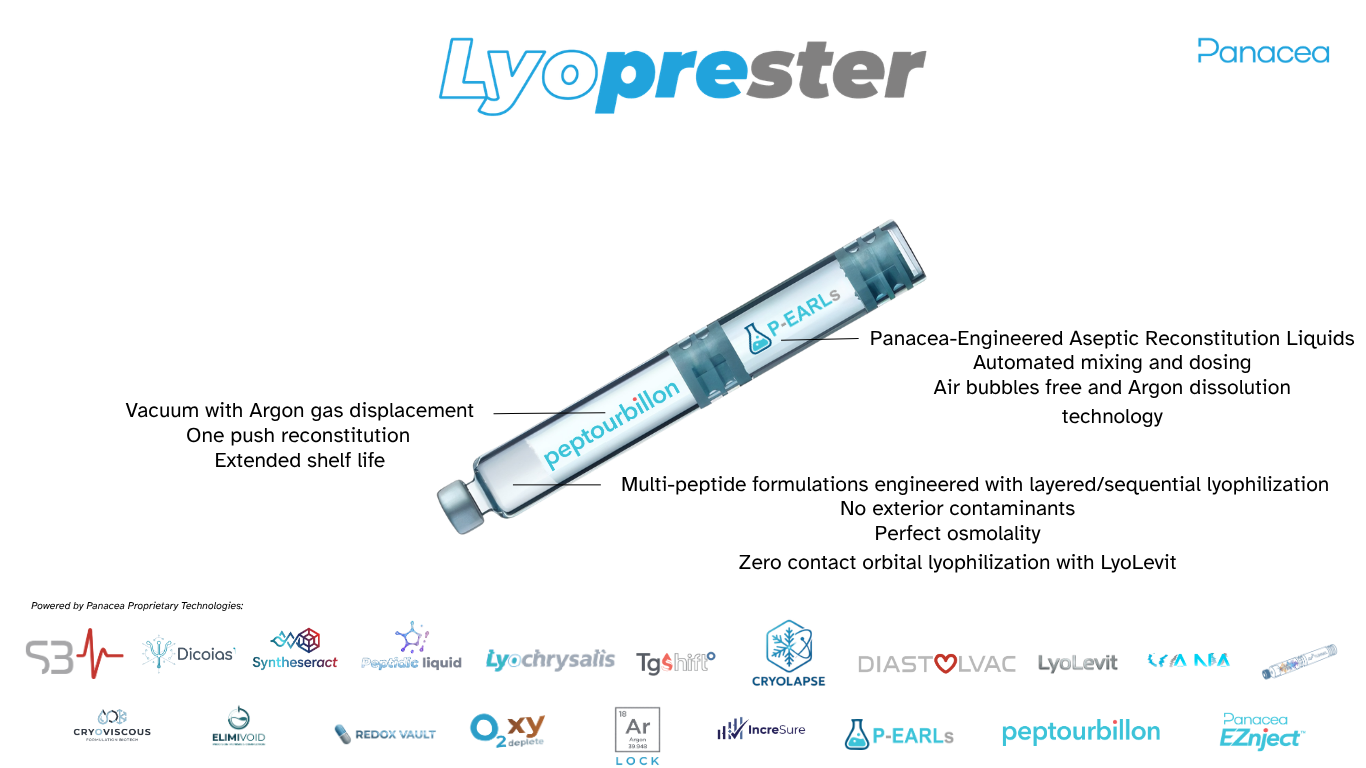
 Lyoprester®The only dual-chamber cartridge that is autoreconstitution-enabled, vacuum-sealed and argon-fillback.lyoprester.com ↗
 P-EARLs™Panacea-Engineered Aseptic Reconstitution Liquid(s) — each tuned to the peptide it wakes.p-earls.com ↗
 Peptourbillon™The layered peptide formulation architecture — single- or multi-layer, never a blend.peptourbillon.com ↗
 RF Tunnel™The RF-formed central channel through the cake.rftunnel.com ↗
 TgShift™Raises the cake’s glass-transition temperature with RF — instead of chilling below it.tgshift.com ↗
 Cryolapse™Cryogenic pressure collapse under S3Pulse™ control — vapour redistributed through the whole cake, not its surface, impeding crust formation.cryolapse.com ↗
 LyoLevit™The cake levitates and spins in high orbit — driven by ultrasound and RF.lyolevit.com ↗
 Lyochrysalis™The integrated chamber housing the whole drying stack.lyochrysalis.com ↗
 S3Pulse™The control brain for every piece of Panacea hardware.s3pulse.com ↗
 Liquiprester™The single-liquid cartridge engineered so multiple peptide APIs coexist in one shared vehicle.liquiprester.com ↗
 Syntheseract™Continuous-flow peptide synthesis in a special, very fast and economical way.syntheseract.com ↗
 CFSPPS™Continuous-flow solid-phase peptide synthesis, written as its own category.cfspps.com ↗
 OxyDeplete™Degassing plus no-headspace doctrine — the oxygen-starved seal.oxydeplete.com ↗
 ArgonLock™The final inert-atmosphere lock under argon.argonlock.com ↗
 RedoxVault™Separation, not merely suppression — redox isolation in lipid micro-reservoirs.redoxvault.com ↗
 PleniDose™The shared filling gantry — one machine filling both the dual-chamber Lyoprester and the liquid Liquiprester.plenidose.com ↗
 IncreSure™The dose-metrology layer — verified API per pen increment.incresure.com ↗
 ElimiVoid™Front-void elimination without touching the metered dose.elimivoid.com ↗
 Cryoviscous™The characterised cold, high-viscosity, low-mobility conditioning state.cryoviscous.com ↗
 Vana Machine™Vacuum–Argon–Nitrogen Architecture — draws the air and nitrogen out of the cake and backfills with argon; in a separate process, the same machine makes the P-EARLs bubble-free.www.vanamachine.com ↗
 EZnject™The disposable auto-injector pen built around the Lyoprester.panaceaeznject.com ↗
 Dicoias ΨThe computed-chemistry advisory — every substance reduced to a vector across physical, electronic and formulation space.dcppsi.com ↗
 SealoPrester™Aseptic Cartridge Closure System — Seal o’ Precision + Sterility.sealoprester.com ↗
 Peptidic LiquidThe peptide formulation in solution — the active plus its buffers, cryoprotectants, lyoprotectants and scaffolders.peptidicliquid.com ↗
 DiastolVAC™Biomimetic diastolic vacuum control — the pneumatic circulatory system of the machine: pumps, valves and sensors as one ensemble.diastolvac.com ↗
 KineticON™Motion Integrity Architecture — the motion-control layer that lets the machine know what happened on every axis move.kineticon.org ↗